I Analyzed Starbucks’ New Loyalty and Lifecycle Strategy

I started with Starbucks’ announcement about its redesigned rewards program, then compared the benefits with the U.S. terms. I wanted to understand what each change actually gave a customer a reason to do.
The first detail that caught my attention was small: one free drink customization, on one selected Monday each month. Starbucks calls it Free Mod Mondays. A member can use that benefit without first saving enough Stars for a free drink. Member FAQ
Useful. Easy to explain. A reason to open the app. Then I got to the expiration rules. A Green member can take a qualifying action to keep expiring Stars alive. Gold and Reserve members get Stars that don’t expire while they maintain their status. U.S. Rewards terms
That changed how I read the program. The same currency comes with different reasons to stay engaged, depending on the relationship a customer has already built with Starbucks.
So I followed those differences through the rest of the benefits. Here’s what stood out, and what I’d take from it as a lifecycle marketer.
First, I wanted to know how much was riding on this
When Starbucks announced the redesign in January, it reported 35.5 million U.S. members active within the previous 90 days, a record for its first fiscal quarter of 2026. January announcement
At Investor Day, it said Rewards members accounted for nearly 60% of U.S. company-operated revenue in fiscal 2025. That’s member spending, not a measurement of revenue caused by the program. But it tells me why the next visit matters so much. Investor Day update
I also found a useful piece of context in Starbucks’ preliminary fourth-quarter 2024 results. The company said more frequent in-app promotions and other marketing investments had failed to improve traffic across both member and nonmember customers. 2024 results
That admission stayed with me as I looked at the redesign. A large audience and more promotions hadn’t been enough. I wanted to see what made the new benefits worth acting on.
The monthly perk gives me something specific to point to
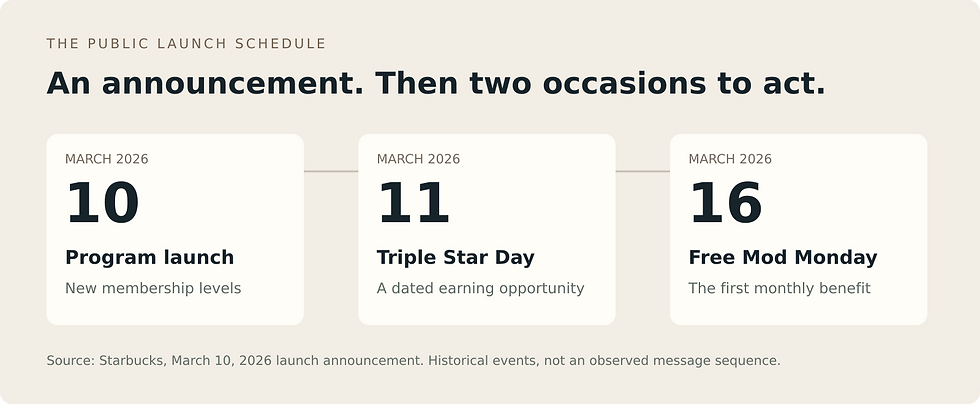
I put the public launch dates next to each other. The redesigned program launched March 10. A Triple Star Day followed on March 11. The first Free Mod Monday was March 16. Launch announcement
That’s a much more useful sequence to examine than a list of new features. The announcement was followed by two dated opportunities to participate.
What I like about the monthly customization is how closely it fits the product. Cold foam is something a customer can experience in the drink they’re holding. It gives the benefit a tangible role in the next visit.
It also gives a member something to use while they’re still building their Star balance.
That’s the question I’d bring into a loyalty planning meeting: what does someone get out of being a member during the wait for their first substantial reward?
Next, I looked at what a smaller balance could buy
The redesign added a 60-Star redemption option. I checked the wording against the terms: it provides $2 off a qualifying item, before tax. U.S. Rewards terms
That adds another decision for the customer. Keep saving, or use a smaller balance now. As a marketer, I’m interested in how clearly the customer understands that choice. A number in an account becomes more useful when someone knows what it gets them.
If I were reviewing a loyalty email, I’d look for that connection. Does the message explain an available benefit? Can the reader tell what to do next? Or have we handed them a balance and left them to work it out?
Those are questions I’d apply to my own messaging. The public materials don’t show me Starbucks’ actual email logic.
The benefit I kept coming back to was more time
Starbucks’ three membership levels are Green, Gold, and Reserve. Members can track progress toward the next level in the app. Launch announcement
The higher levels earn Stars faster:
Membership | Stars per qualifying $1 spent |
Green | 1 |
Gold | 1.2 |
Reserve | 1.7 |
U.S. base earning rates; bonuses and exclusions are separate. Member FAQ
But the birthday benefit caught my attention for a different reason. Eligible Green members redeem it on their birthday. Gold members get seven days. Reserve members get 30. Member FAQ
I like how practical that is. More time gives a customer more freedom to use a benefit when it fits their life. It made me think about what we choose to improve in a loyalty program. We can increase the reward, but we can also make it easier to enjoy. That second option deserves a place in the discussion.
Then I went back to the expiration rules
This was the detail that pulled the rest of the story together for me.
Green members can extend expiring Stars by a month through a qualifying purchase, a reward redemption, or a Star-earning digital reload of at least $30. The action must happen in the month before expiration. Gold and Reserve members avoid expiration while they maintain their status. U.S. Rewards terms
For a Green member with expiring Stars, there’s a specific action available now. For someone at a higher level, continued status carries the convenience of keeping those Stars active.
My reading is that the program gives these customers different things to value. The communication needs to respect that difference. That’s where I’d start an audit: does every benefit message match the member’s actual situation? Eligibility, timing, balance, and status all matter. An accurate explanation is part of the experience we’re promising.
What I can take from this, and what I can’t
I can follow the published rules and explain the opportunities they create. I can’t tell you how many incremental visits Free Mod Mondays generated from the materials reviewed here.
Starbucks’ July 2026 update described improving performance alongside changes to service, order sequencing, menus, coffeehouses, and Rewards. I wouldn’t credit the overall improvement to one loyalty benefit. Third-quarter update
What I’m taking away is a more useful way to review a program: look at what a member can do with it today, what becomes available next, and what makes the relationship more valuable over time. For Starbucks, the published benefits provide concrete answers at each of those points. For another brand, the answers will depend on its customers and product.
I’d put those answers next to the campaign calendar before writing another message. Then I’d measure whether the benefits produce additional visits and enough additional business to cover their cost.
The question I’d leave on the brief is simple: what has become useful to this customer since the last time we asked them to come back?
Research note: This first-person investigation describes desk research performed for this article using Starbucks’ public U.S. announcements, member FAQ, and terms. No purchases, interviews, or access to internal campaigns are claimed. The strategic observations are editorial analysis. Historical events are dated; benefits remain subject to program terms.
Comments